Wired: Thorium Reactors
Please take a look at the recent article from Wired.com, on thorium reactors!
[ Link ]
Please take a look at the recent article from Wired.com, on thorium reactors!
[ Link ]
![piketon[1] piketon[1]](http://nuclearactive.com/wp-content/uploads/2009/06/piketon1.jpg)
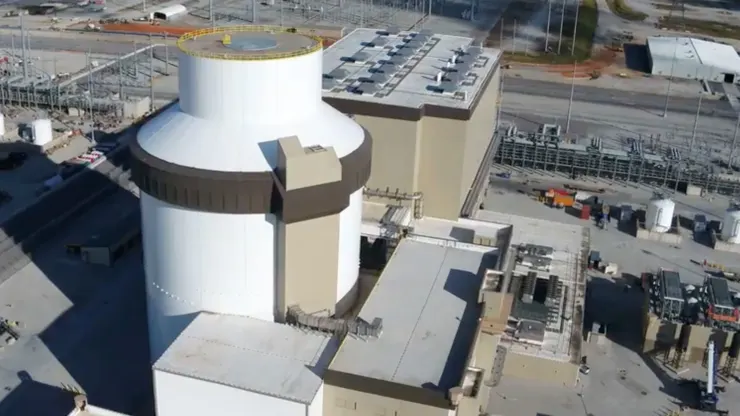
The proposed site is the location of the Portsmouth gaseous diffusion uranium enrichment plant, which operated from 1954 to 2001. The plant and its facilities were then kept in ‘cold standby’ until 2005, when they entered ‘cold shutdown’, and decontamination and decommissioning began. In 2004, US enrichment company USEC selected the Portsmouth site as the home of its American Centrifuge enrichment plant, currently under construction and due to begin commercial operations in 2010.
Ohio Governor Ted Strickland said: “The project will revitalize the region’s economy, further advance Ohio’s nuclear infrastructure, help address our energy needs and be part of Ohio’s solution to the challenge of climate change.”
Babcock & Wilcox announced its intention to put smaller, rail-delivered 125 MW reactor modules, into production by 2018. These units are one-tenth the size of a typical nuclear plant, and this makes them suitable for rural and third-world applications. These reactors are rated for 60 years, with refueling every 5 years.
Source: NuclearStreet.com]
By Stephen Heiser -
An approximate 38-megawatt increase in output at an Exelon Nuclear plant last week launched a series of planned power uprates across the company’s nuclear fleet that will generate between 1,300 and 1,500 megawatts of additional generation capacity within eight years without turning a spade of earth, Exelon Nuclear President and Chief Nuclear Officer Charles (Chip) Pardee said today.
The first of the new, carbon-free nuclear megawatts was officially confirmed last week following equipment upgrades at Exelon’s Quad Cities nuclear plant near Cordova, Ill. Other uprate projects are underway and Exelon plans to have the full measure of new megawatts on the grid by 2017.
“With these uprates, we will be able to produce the equivalent output of a new advanced nuclear reactor, and we’ll bring it to market in a timeframe commensurate with the fastest new construction,” Pardee said. “These uprates are a critical component of Exelon 2020, the company’s plan to eliminate the equivalent of its 2001 carbon footprint by 2020.”
Uprate projects improve the efficiency and increase electricity output of a nuclear generating unit through upgrades to plant equipment. The projects take advantage of new production and measurement technologies, new materials and learning from a half-century of nuclear power operations.
The remainder of uprate megawatts will come from additional projects at nine Exelon plants beginning in 2010 and ending in 2017.
At 1,500 nuclear-generated megawatts, the uprates would displace 8 million metric tons of carbon emissions annually that would otherwise come from burning fossil fuels.
Exelon operates the largest fleet of commercial nuclear reactors in the United States and the third largest in the world. A series of plant upgrades and uprates over the past 10 years have already added approximately 1,100 new megawatts to Exelon Nuclear’s generation.
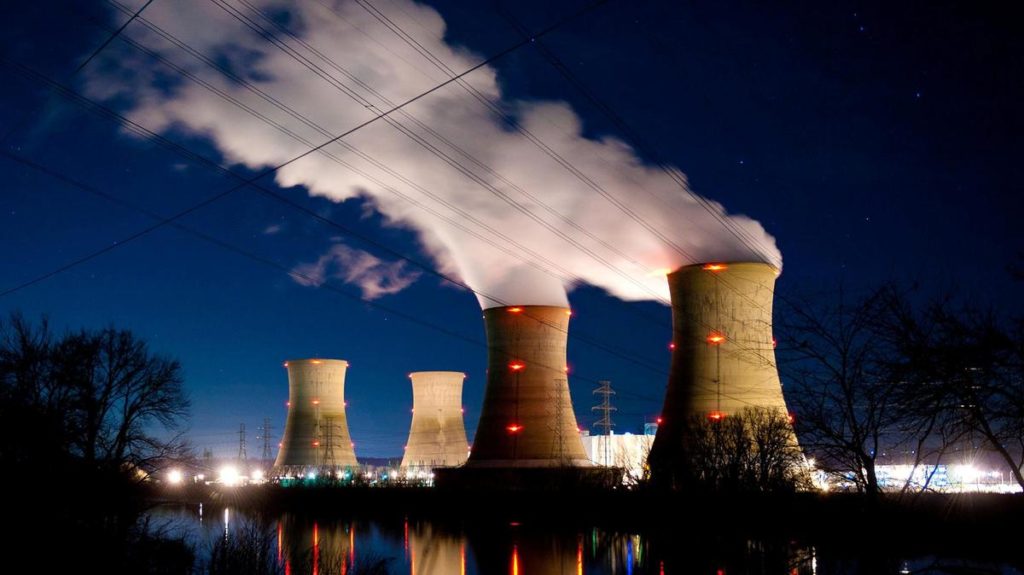
SNL video of an F-4 Phantom II (68,000 pounds) smashing into a section of reactor containment vessel at over 500 mph. The result is barely a scratch on the inside of the vessel. This is how modern nuclear reactors are built, with a six-foot wall of steel-reinforced concrete that can resist this kind of impact. Nuclear reactors are designed damn tough, to keep contamination inside in the worst case scenario. This is not how Chernobyl was designed, and this is why the results were disastrous. This is how Three-Mile Island reactor was designed, and that is why the nearby city was unaffected and the plant still operates today. Well-built reactors are safe to live by, and safer and cleaner than alternative fuel sources.
Many people are eager to stop using fossil fuels, but they are very reluctant to accept that nuclear power can be a “greener” alternative. It’s true. Fossil fuels pump pollution and radiation into the atmosphere, but did you know that coal-fired plants release hundreds of times the radiation of a typical nuclear plant?
Here’s a study by ORNL on coal plant radiation releases:
http://www.ornl.gov/info/ornlreview/rev26-34/text/colmain.html
[From IEEE Spectrum, Energy Wise.]
Two of the largest Japanese utilities, Kyushu Electric Power and Shikoku Electric Power, are preparing to fuel nuclear reactors with rods containing recycled plutonium starting this fall, John Boyd reports from Tokyo. In the middle of last month, two ships arrived from France with loads of mixed-oxide fuel (MOX) containing plutonium that originated in Japanese spent fuels, which Japan is contractually obligated to take back. The MOX consignment from France’s La Hague reprocessing complex weighed an estimated 1700 kilograms.
The recycling of nuclear fuels has been intensely controversial for decades, mainly because of concerns that fuel containing plutonium could fall into the hands of terrorists. Well before Al Qaeda appeared on the scene and fanatics were killing themselves in bomb attacks, experts worried about the ease with which the plutonium in MOX could be separated from uranium, to provide the explosive material for an atomic bomb. [Would you like to know more?]
In exciting news, Los Alamos National Laboratory (LANL) announced this past week the first shipments of remote-handled transuranic waste to the WIPP facility in southern New Mexico.
The Laboratory plans to prepare three to four shipments per week until all 16 canisters are gone.
Thanks to shielding and design, a loaded RH-TRU shipping cask meets the same Department of Transportation radiation safety requirements as a typical shipment to WIPP. Stringent handling procedures and satellite surveillance will keep the public safe.
The shipments will follow preapproved transportation routes. As with all shipments to WIPP, these operations will be coordinated with New Mexico law enforcement.
WIPP has conducted more than 7,200 shipments of transuranic waste since opening in 1999, including more than 200 shipments of RH-TRU.
[reprinted from nullsession.net]
Radiation is natural, yet the very word itself generates an irrational fear in most people. Why? Nuclear science is still a relatively young science, and people picture exploding atom bombs when they think of radiation. They think of Three-Mile Island and Chernobyl and a thermonuclear holocaust. Yet, as this BBC documentary points out, this fear is not rational and often it is the fear of radiation that causes psychological trauma.
Radiation is all around us. In nature, something is either matter or radiation. Electromagnetic radiation includes radio waves, microwaves, infrared, visible light, ultraviolet light, x-rays and gamma rays. We are submerged in an ocean of radiation fields. Energetic charged particles are also all around us, from the breakdown of heavier elements, yet most do us no harm at all. There are four tons of uranium in the top foot of every square mile of land. People live in regions with higher background radiation than the well-known reactor accident caused in the Russian city of Chernobyl, and they thrive. Some even suspect, as I have suggested before, that some level of background radiation is important to the stimulation of the body’s immune system.
While the higher levels of exposure to radiation is known to be dangerous (such as the fluoroscopes that many children played with to view bones in their feet at the shoe stores in the 1940s and 1950s) - there is little radiation danger presented in modern nuclear reactors, yet the irrational phobia about radiation halted the construction of new US nuclear reactors nearly thirty years ago. There are very real risks that come from our continued use of fossil fuels. Nuclear power, today, is a very safe and reliable technology, and we need to leverage this plentiful source of cheap energy. This means we must overcome the uneducated fear of anything related to radiation or radioactivity.

Safe Containment
The container, called Transuranic Packaging Transporter Model 2, or TRUPACT-II, is:
A series of stringent tests conducted on the container included:
The tests showed that the container would hold its seal and prevent release of radioactivity to the atmosphere.
Safe Storage at WIPP
Why Salt?
Let’s look at storage at the WIPP facility in New Mexico, as an example.
Government officials and scientists chose the Waste Isolation Pilot Plant (WIPP) site through a selection process that started in the 1950s. At that time, the National Academy of Sciences conducted a nationwide search for geological formations stable enough to contain wastes for thousands of years. In 1955, after extensive study, salt deposits were recommended as a promising medium for the disposal of radioactive waste. Since then, bedded salt has been one of the leading candidates for the permanent disposal of radioactive waste.
Why is salt the material of choice for the planned disposal of some nuclear waste? Are there advantages to rock salt?
Salt offers the following advantages:
Salt formations at the WIPP were deposited in thick beds during the evaporation of an ancient ocean, the Permian Sea. These geologic formations consist mainly of sodium chloride rock, the same substance that, in granular form, is in a salt shaker on the kitchen table. The primary salt formation containing the WIPP mine is about 2,000 feet thick, beginning 850 feet below the surface.
Formed about 225 million years ago during the Permian Age, large expanses of uninterrupted salt beds provide a repository free from the disturbances of large earthquakes. That proven stability over such a long time span offers the predictability that the salt will remain stable for a comparatively short quarter million years. That’s about how long the WIPP-bound waste will take to lose most of its harmful radioactivity and no longer be a threat to the environment.
At the depth of the WIPP repository, the salt will slowly encapsulate the buried waste in the stable rock. Relatively small amounts of brine, salt-saturated water, were trapped in the formations millions of years ago. Moisture and salt molecules in the brine will help the recrystallization process to naturally encapsulate the waste in the salt. Meanwhile, salt rock also provides shielding from radioactivity similar to that of concrete.
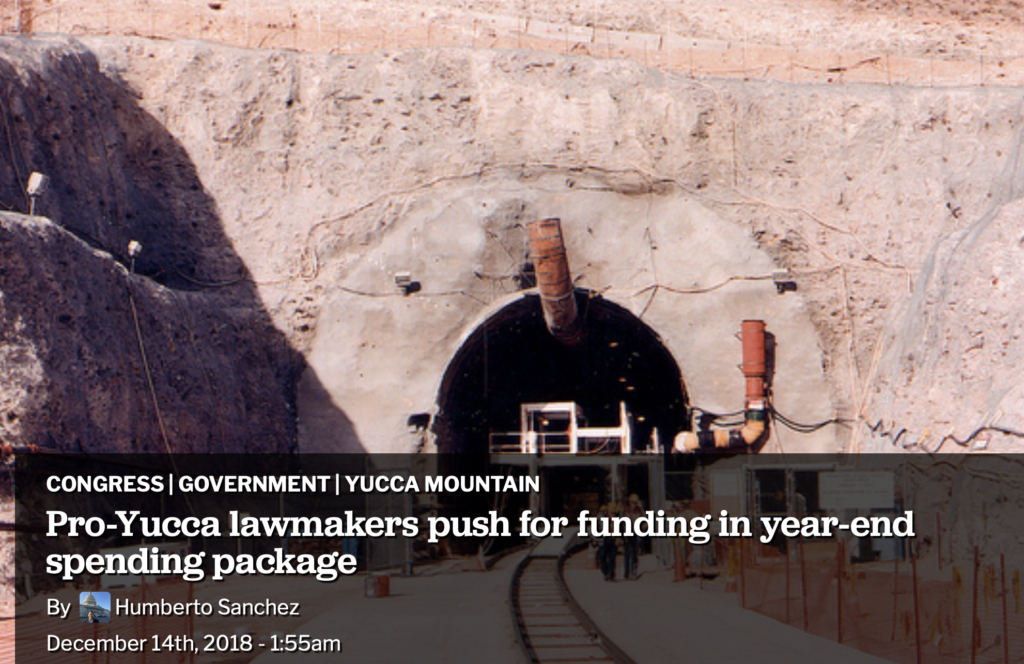
In a future post, I will review the Yucca Mountain facility and the reasons it was selected as a long-term waste storage facility. Because of political pressure, and public misconceptions due to unfair media portrayals and the dissemination of incorrect information from some environmental groups, it may be difficult to ever find a permanent waste storage facility in the US. I will also cover how the nuclear industry is dealing with a failure of the political system to approve new storage facilities, and how even this is tremendously safe!
Dr. John D. Johnson has a background in nuclear, experimental & accelerator physics. He worked for Los Alamos National Laboratory in the 1990s, and currently teaches university physics, astronomy & ethics.